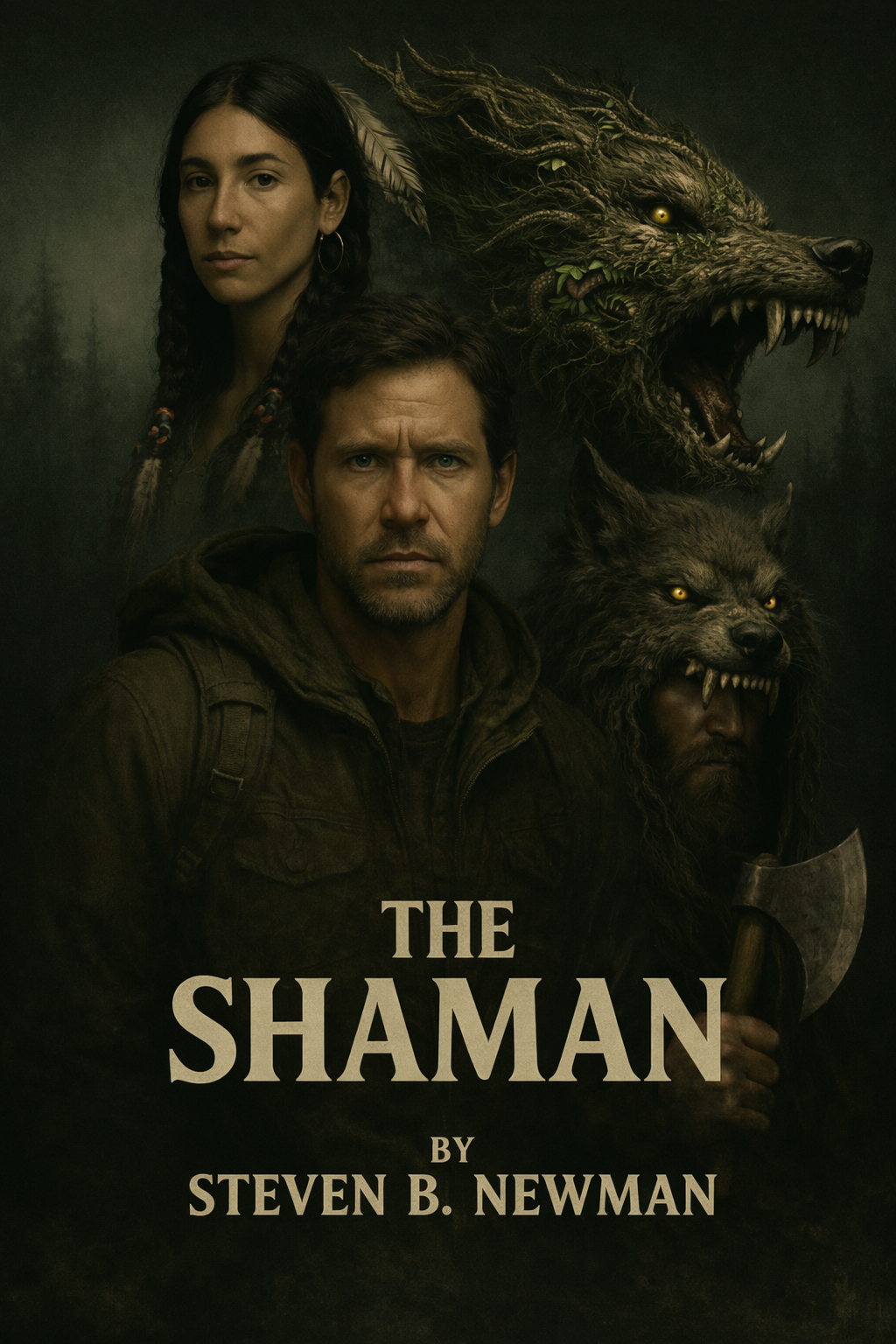

Project Snapshot
Genre
Mythic Thriller / Supernatural Adventure
Tone
Atmospheric, mythic, character-driven drama with grounded realism and spiritual depth
Setting
The Appalachian Trail and pre-colonial North America — where past and present collide
Themes
Rage vs. Redemption
Ancestral Inheritance
Balance Between Man and Nature
The Burden of Violence and the Possibility of Mercy
Spiritual Reconciliation Across Cultures and Time
Status
Feature Screenplay • Proof-of-Concept in Development
Studio
Origin Works — An Origin Works Original
Explore the story below or request the full development deck.


-
LOGLINE
A battle-scarred Green Beret hiking the Appalachian Trail is drawn across time by a Cherokee shaman into pre-colonial North America, where he must confront a berserker ancestor whose ancient rage mirrors his own and break a violent curse before it claims his life and condemns the land to endless bloodshed.
BRIEF SYNOPSIS
Erik Ward, a retired Green Beret carrying decades of war, sets out to thru-hike the Appalachian Trail in search of peace. Deep in the mist-shrouded Blue Ridge Mountains, he encounters Cornsilk, a Cherokee woman whose presence unsettles time itself. What begins as an unlikely companionship becomes a passage into another age—one shaped by ancestral memory, unfinished violence, and the cost of rage.
Drawn across centuries into a living pre-colonial world, Erik discovers that the fury he has spent his life suppressing is not solely his own. It is an inheritance—born of a Norse warrior whose berserker rage once scarred the land, and a woman who has guarded that legacy across generations. Among the Cherokee people, Erik is not a savior, but a witness—forced to endure trials that test not his strength, but his restraint.
As past and present collide, Erik must decide whether violence is his destiny or his burden to release. In facing the ancestor who embodies his darkest self, Erik confronts a truth no battlefield ever demanded of him: rage may offer power, but only mercy offers freedom.
Two worlds. One inheritance. A choice between rage and redemption.
-
The Shaman blends several mythic traditions into a single modern story. At its core lies an ancient symbolic conflict between the wolf and the corn — two archetypes representing violence and survival on one hand, and balance and life on the other. In Norse mythology the wolf symbolizes primal warrior rage, embodied in the berserker tradition. In Native American cosmology, corn represents continuity, harmony, and the sustaining relationship between humanity and the land.
The story follows Erik, a modern man who discovers he is bound by bloodline to a Viking berserker from a thousand years ago. Guided by the mysterious Cornsilk, he must confront this ancestral shadow and decide whether he will be consumed by the rage of his past or transform it into something new.
Set against the sacred landscape of the Appalachian wilderness and the summit of Mount Katahdin, The Shaman ultimately becomes a story of reconciliation — a modern American myth about inheritance, identity, and the choice to master the wolf within. description
-
The Shaman was inspired by the author’s time hiking the Appalachian Trail and years spent reflecting on the lingering echoes of war. The idea first emerged while walking through the forests of the Blue Ridge Mountains, where the boundary between memory and landscape began to blur.
The story grew from a simple question: what if the battles we fight are not only our own, but echoes carried through generations? By blending Norse mythology, Native American spiritual traditions, and the timeless pull of the Appalachian wilderness, The Shaman explores the possibility that confronting our past may be the only way to find peace.